— Mysteria Gaudii —
The Joyful Mysteries.
The Word made flesh.
Pray the five Joyful Mysteries of the Incarnation on Mondays and Saturdays, meditating on each while praying a decade: one Our Father, ten Hail Marys, and one Glory Be.
The five mysteries of the Incarnation. The angel's announcement. The mother's song. The newborn King in the cave. The old prophet's hymn. The boy Christ in his Father's house. The Rosary as the Church has prayed it for five centuries — given back with sacred art rendered for the man who wants to see what he is meditating on.
“Magnificat anima mea Dominum, et exsultavit spiritus meus in Deo salutari meo.”
My soul doth magnify the Lord, and my spirit hath rejoiced in God my Saviour.
Luke 1:46–47 · Douay-Rheims
Full-screen images, one mystery at a time. Made for praying with a phone in your hand.
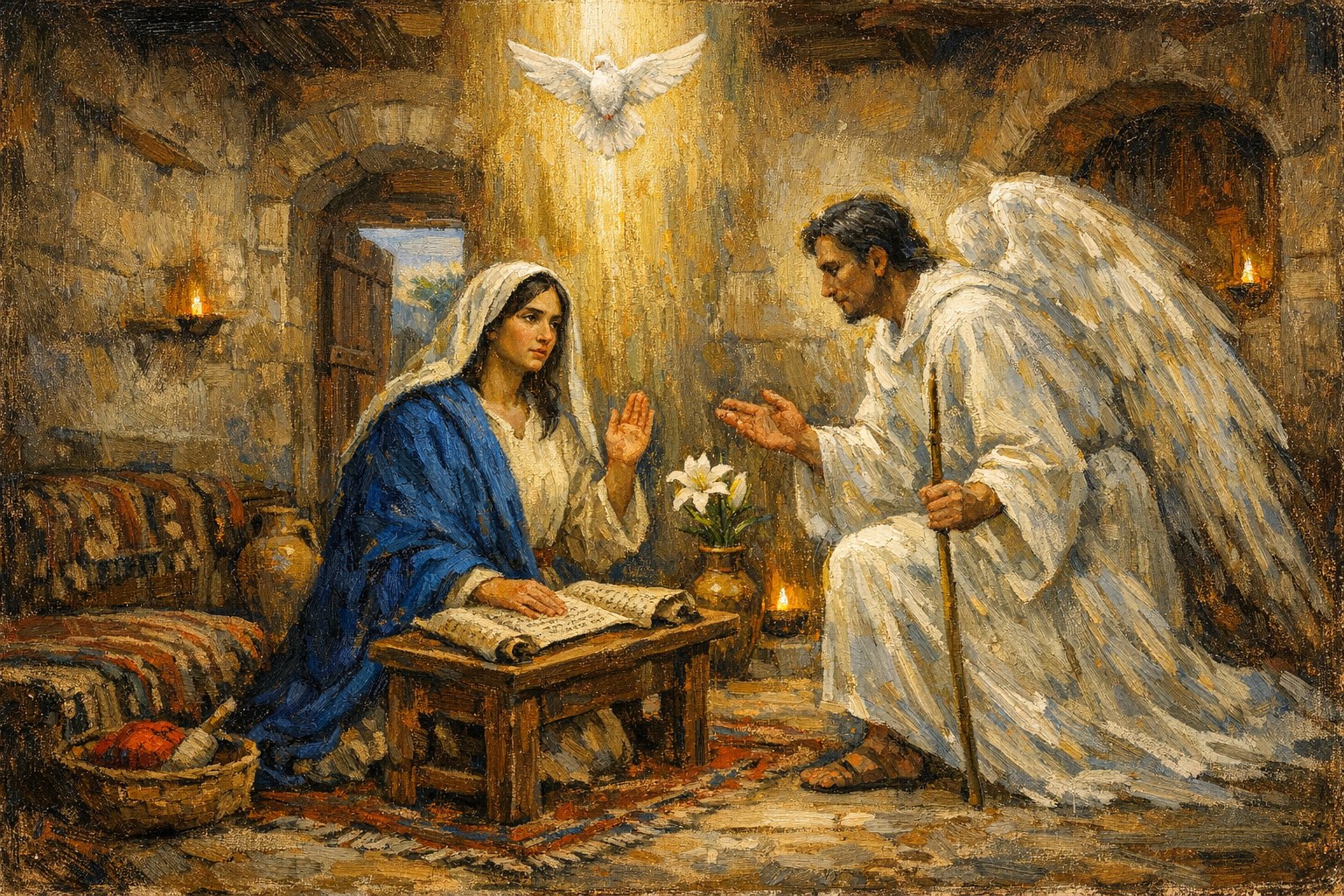
I.The First Joyful Mystery
The Annunciation
— Annuntiatio Domini —
“Behold the handmaid of the Lord; be it done to me according to thy word.”
— Luke I : 38
An angel standing in her father's house in Nazareth. Hail, full of grace, the Lord is with thee. The greeting was not the greeting of a stranger. The angel had been sent because the Lord was already with her — had been from the moment of her own conception, kept clean from the stain of Adam, prepared from the foundation of the world to be the body God would borrow.
She asked one question — how shall this be? — and accepted the answer. Behold the handmaid of the Lord; be it done to me according to thy word. A teenage Galilean Jewish girl in a village of four hundred people consenting to be the New Eve, to undo the disobedience of the first Eve by the obedience of her fiat. The race of Adam was saved by the fiat of a girl.
She did not know yet what her yes would cost. The sword Simeon would prophesy at the Presentation, the Cross at Calvary, the body that came out of her own body broken on Roman timber — none of it was disclosed. The grace was: she said yes anyway. Pray for the grace to say yes to what God is asking of you today, before he tells you what it costs.
Fruit of the Mystery — Humility
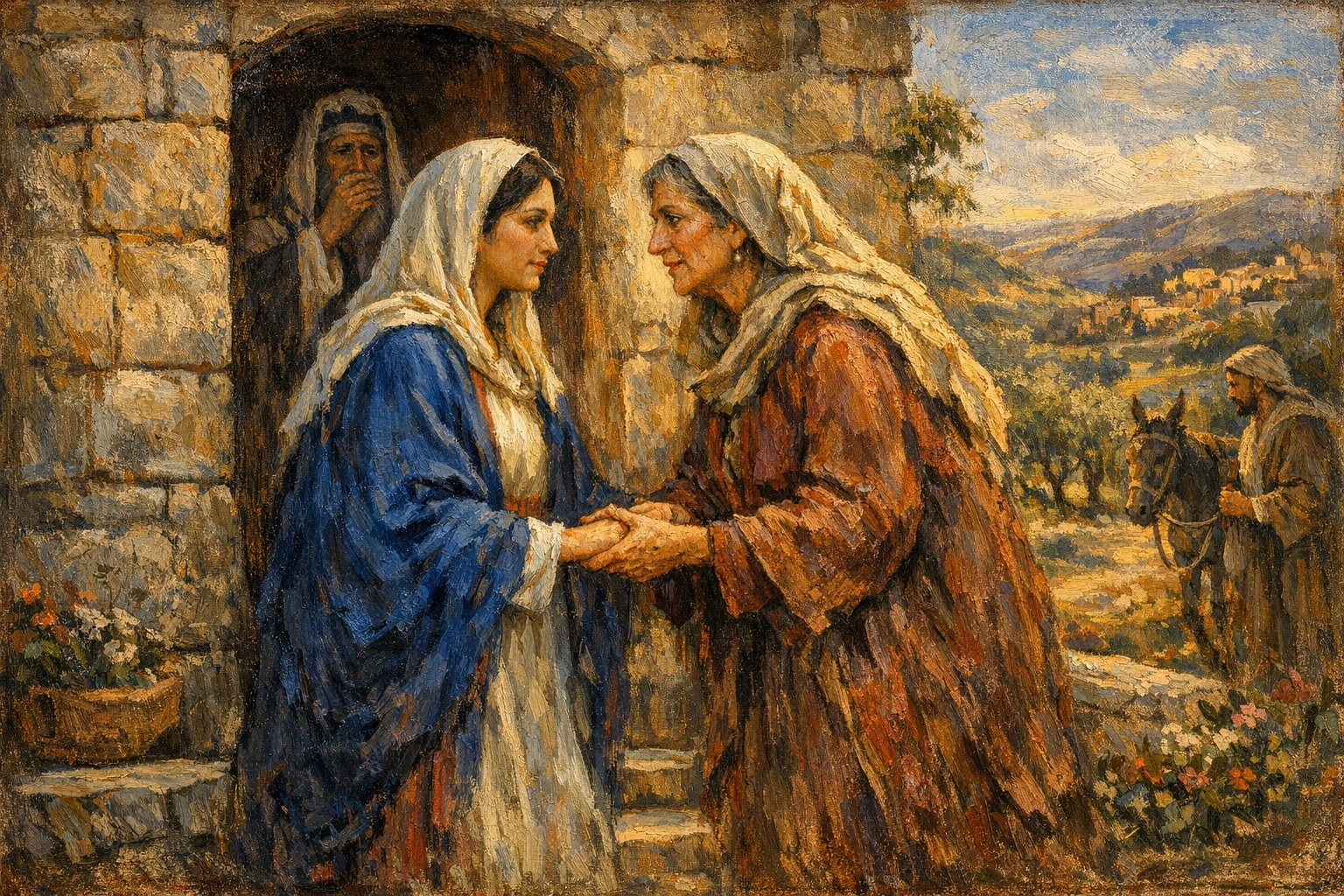
II.The Second Joyful Mystery
The Visitation
— Visitatio Beatæ Mariæ Virginis —
“Blessed art thou among women, and blessed is the fruit of thy womb. And whence is this to me, that the mother of my Lord should come to me?”
— Luke I : 42–43
Mary was perhaps four days into her own pregnancy when she set out from Nazareth on the eighty-mile walk to the hill country of Judah. Her cousin Elizabeth, six months pregnant in old age, was the only other person in the world who knew what it was to bear a miracle in her body. Mary did not wait. She went.
At the threshold, the unborn John leaped in his mother's womb. Elizabeth, filled with the Holy Spirit, recognized the Mother of her Lord. Blessed art thou among women, and blessed is the fruit of thy womb. The first words of veneration of Mary, spoken in the Spirit by the mother of the Forerunner. Mary's response was the Magnificat — a song that has been prayed in the evening prayer of the Church for two thousand years.
The Magnificat is not a soft song. He hath put down the mighty from their seats, and exalted them of low degree. It is the prayer of a woman whose Son will overturn the kingdoms of this world. The Catholic man learns charity here: not as sentiment, but as the willingness to walk the eighty miles to bear what your brother needs. Mary stayed three months. She did not stay because she was sentimental. She stayed because Elizabeth needed her.
Fruit of the Mystery — Charity & Love of Neighbor
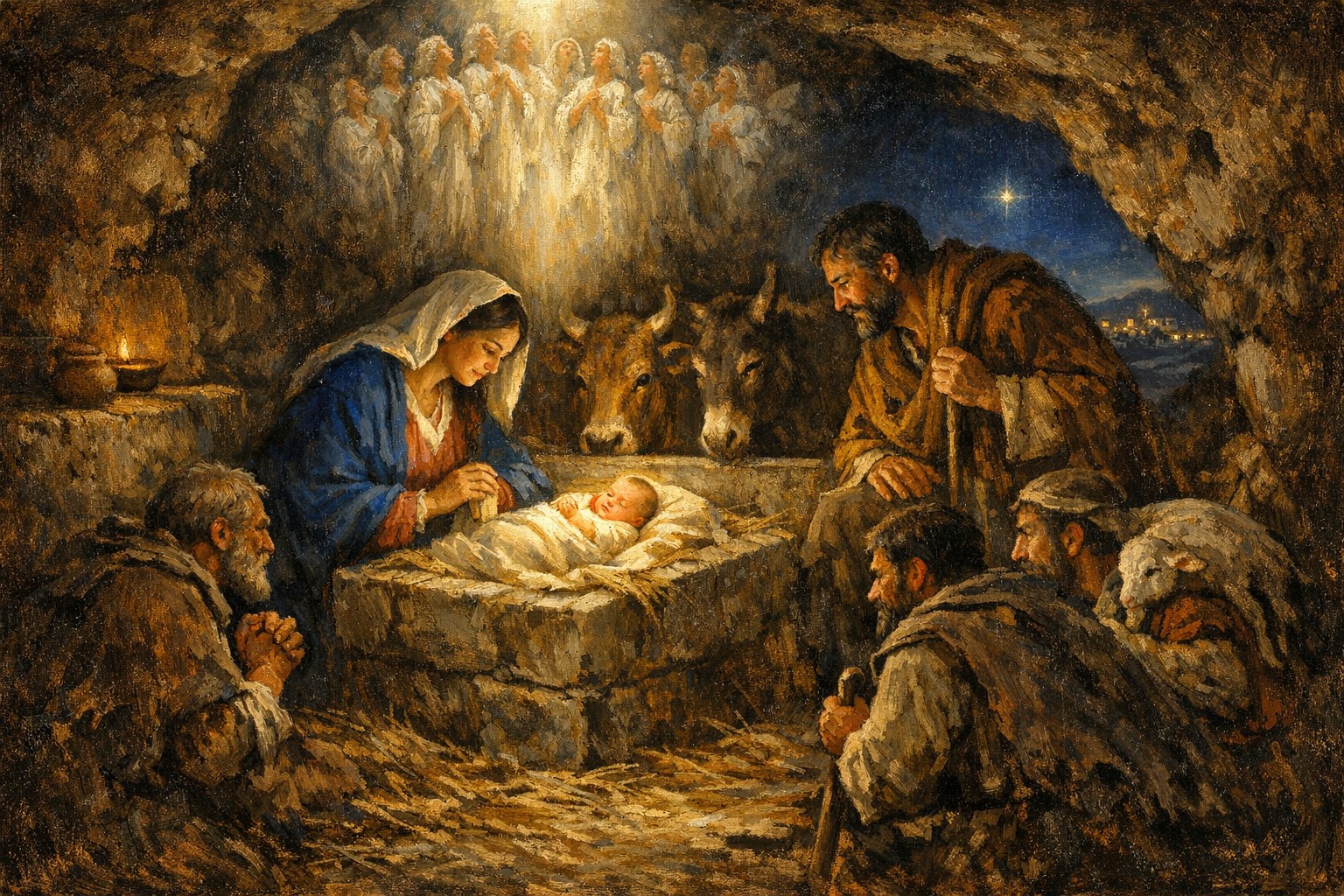
III.The Third Joyful Mystery
The Nativity of Our Lord
— Nativitas Domini —
“And she brought forth her firstborn son, and wrapped him up in swaddling clothes, and laid him in a manger; because there was no room for them in the inn.”
— Luke II : 7
It was a cave used as a stable on the outskirts of Bethlehem. The owner had let out every room. Joseph asked. They told him no. Mary gave birth where the animals slept. She wrapped her newborn Son in linen swaddling cloth and laid him in the stone trough where the ox and the ass were fed. The Light of the World came out of a teenage virgin's body in the dark of night, and the only witnesses were her husband, two animals, and a few Judean shepherds the angels brought from the field.
The poverty was the message. Not as accident, not as sentiment — as deliberate choice. The Father chose for his Son the lowest manger and the highest poverty and the most invisible village in the empire. The men who would walk into that cave first were not the priests of the Temple or the scribes of Jerusalem. They were shepherds — the people the Pharisees considered ritually unclean and excluded from the synagogue. The Kingdom is upside-down from the start.
Pray for poverty of spirit. Not literal financial destitution, necessarily — but the detachment that recognizes that whatever you have, you do not own. You are stewards of every dollar, every hour, every relationship, every breath. The man whose hands are open can be filled. The man whose hands are clenched is empty no matter what is in them.
Fruit of the Mystery — Poverty of Spirit & Detachment
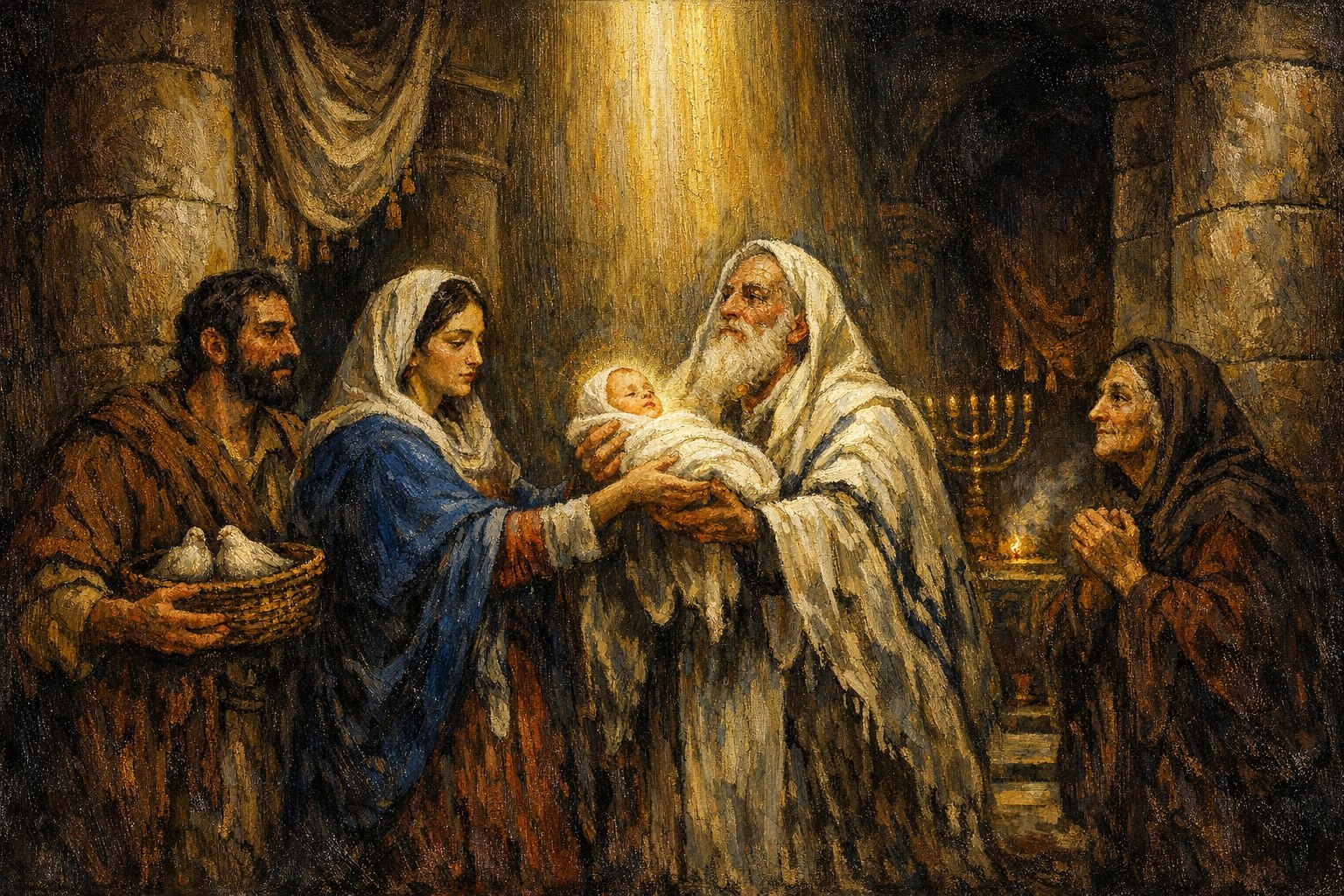
IV.The Fourth Joyful Mystery
The Presentation in the Temple
— Praesentatio Domini —
“Now thou dost dismiss thy servant, O Lord, according to thy word in peace; Because my eyes have seen thy salvation.”
— Luke II : 29–30
Forty days after the birth, the Holy Family walked the eight miles from Bethlehem to Jerusalem to fulfill the Law of Moses (Lev 12). They could not afford the lamb required of those above the poverty line, so they brought the offering of the poor: two turtledoves, or two young pigeons. The Mother of God herself, observing the rabbinic period of post-natal impurity. The Son of God himself, carried into his Father's house.
Simeon was waiting. An old, righteous, devout Jewish man who had been promised by the Holy Spirit that he would not see death before he saw the Lord's Christ. He had been waiting his whole life. When he saw the forty-day-old infant in Mary's arms, he took the Child up and prayed the words the Church has chanted at Compline ever since: Now thou dost dismiss thy servant, O Lord, according to thy word in peace; Because my eyes have seen thy salvation.
Then Simeon turned to Mary and prophesied the first prophecy of the Cross. Behold, this child is set for the fall and rising again of many in Israel; and for a sign which shall be spoken against; (yea, a sword shall pierce through thy own soul also.) The Sword. The Stabat Mater. The Crucifixion thirty-three years ahead. Mary was told. The Joyful Mysteries already cast the shadow of the Sorrowful.
Fruit of the Mystery — Obedience
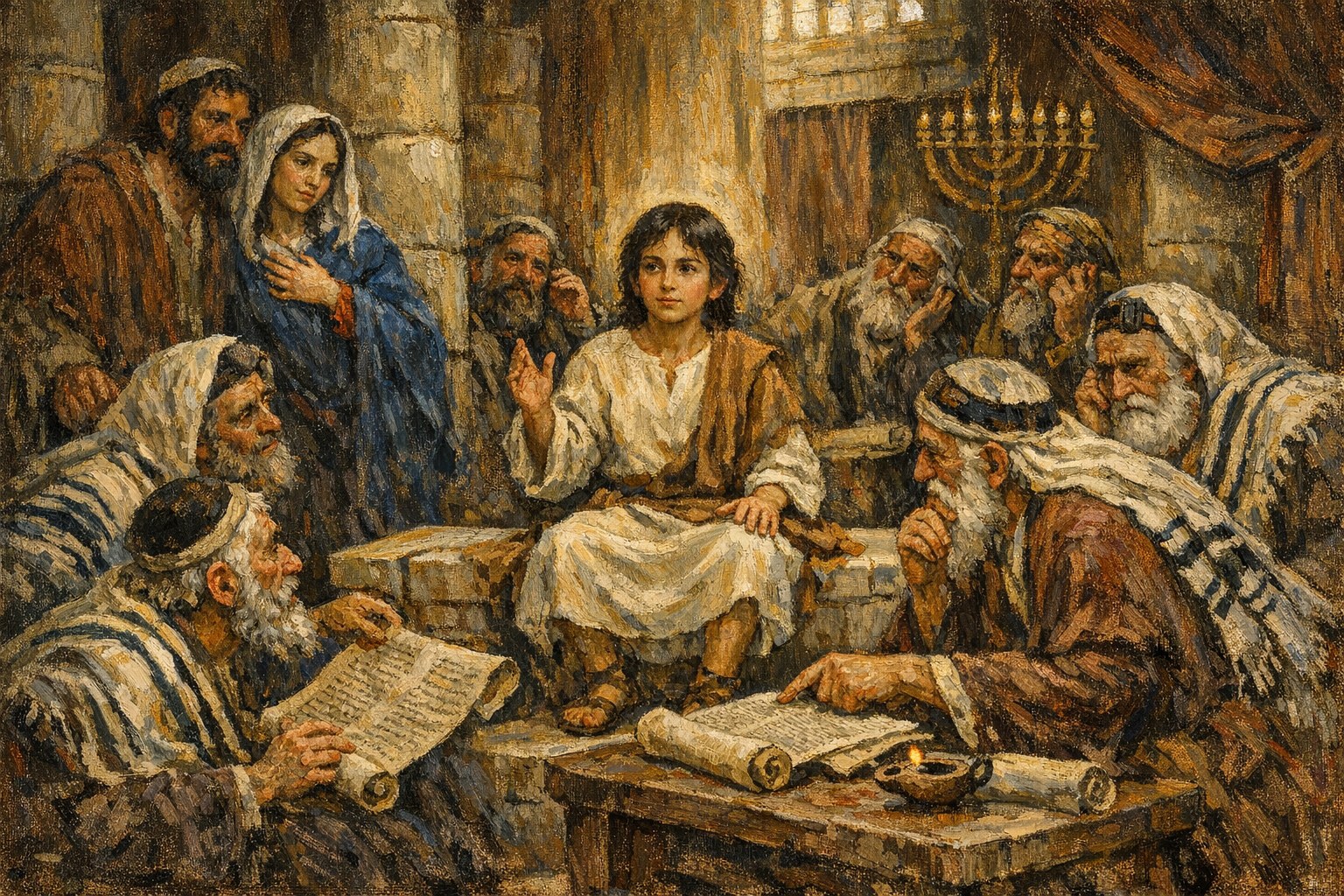
V.The Fifth Joyful Mystery
The Finding in the Temple
— Inventio Iesu in Templo —
“How is it that you sought me? did you not know, that I must be about my Father's business?”
— Luke II : 49
The Holy Family went up to Jerusalem every year for Passover. When Jesus was twelve — the age of Jewish religious responsibility — they made the pilgrimage as they had every year. After the feast, they began the return journey north to Galilee, traveling in the caravan of pilgrims from Nazareth and the surrounding villages. Mary assumed Jesus was traveling with the men; Joseph assumed he was with the women. By the end of the first day of the journey, when the caravan stopped for the night, neither could find him. They turned back to Jerusalem. They searched for three days.
They found him in the Temple, sitting in the midst of the doctors of the Law — the zaqenim, the elders and scribes who taught in the Temple courts. He had been "hearing them, and asking them questions" (Lk 2:46). The doctors were astonished at his understanding. Mary's words, the gentle reproach of the mother who has searched for three days: Son, why hast thou thus dealt with us? And then his answer — the FIRST WORDS OF CHRIST recorded in Scripture: How is it that you sought me? did you not know, that I must be about my Father's business?
The Catholic man learns this discipline: when he loses Christ, he searches for three days in the streets of his life and at last finds him in the Temple — at the Mass, in the confessional, in the Eucharist. That is where he always was. That is where you go to find him. The boy Christ went down with his parents to Nazareth and was subject to them. He grew. He waited. The thirty hidden years had begun.
Fruit of the Mystery — Joy in Finding Christ
Pray it tonight.
She bore him for nine months, raised him for thirty years, and walked with him to the foot of the Cross. The Joyful Mysteries are the years she said yes. Pray the decade. Walk to confession. Take up your watch.
Per Mariam ad Iesum.
Through Mary, to Jesus.
The other sets — Sorrowful · Glorious · Luminous · All four sets