— Mysteria Doloris —
The Sorrowful Mysteries.
The price he paid.
Pray the five Sorrowful Mysteries of the Passion in order, meditating on each scene while praying one Our Father, ten Hail Marys, and a Glory Be per decade. They are traditionally prayed on Tuesdays and Fridays, and throughout Lent.
The five mysteries of the Passion. The cup he chose. The body he gave. The crown of thorns. The cross he carried. The death that bought the world. The Rosary as the Church has prayed it for five centuries — given back with sacred art rendered for the man who wants to see what he is meditating on.
“Stabat Mater dolorosa, juxta crucem lacrimosa.”
The sorrowing Mother stood, weeping by the cross.
Full-screen images, one mystery at a time. Made for praying with a phone in your hand.
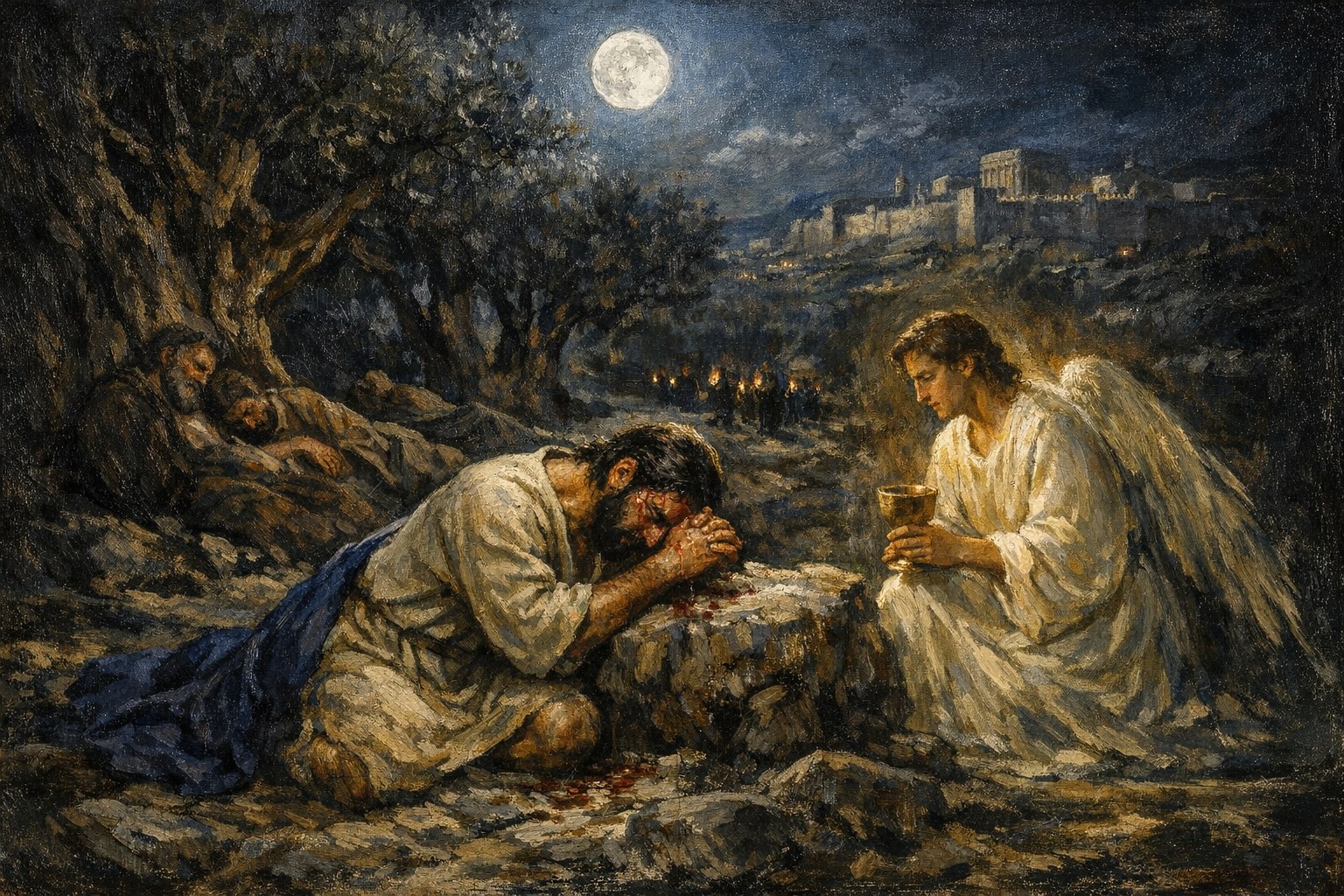
I.The First Sorrowful Mystery
The Agony in the Garden
— Agonia in Horto —
“And being in an agony, he prayed the longer. And his sweat became as drops of blood, trickling down upon the ground.”
— Luke XXII : 44
Three times he prayed. Three times he asked the Father if it could be otherwise. Three times the answer was the same — and three times he said amen. The will of the Son aligned with the will of the Father by the slow surrender of the human heart inside the divine Person who already knew the answer.
He sweated blood. Hematidrosis, the rare phenomenon under extreme stress where capillaries near the sweat glands rupture and blood mixes with sweat. The body bleeding before any blow had fallen. The agony was real. The cost was real. He chose it anyway.
Three apostles slept fifty paces away. Judas was already coming with the torches. The Garden was the watch he kept alone — and pray that when your watch comes, you will not sleep through it.
Fruit of the Mystery — Conformity to God's Will
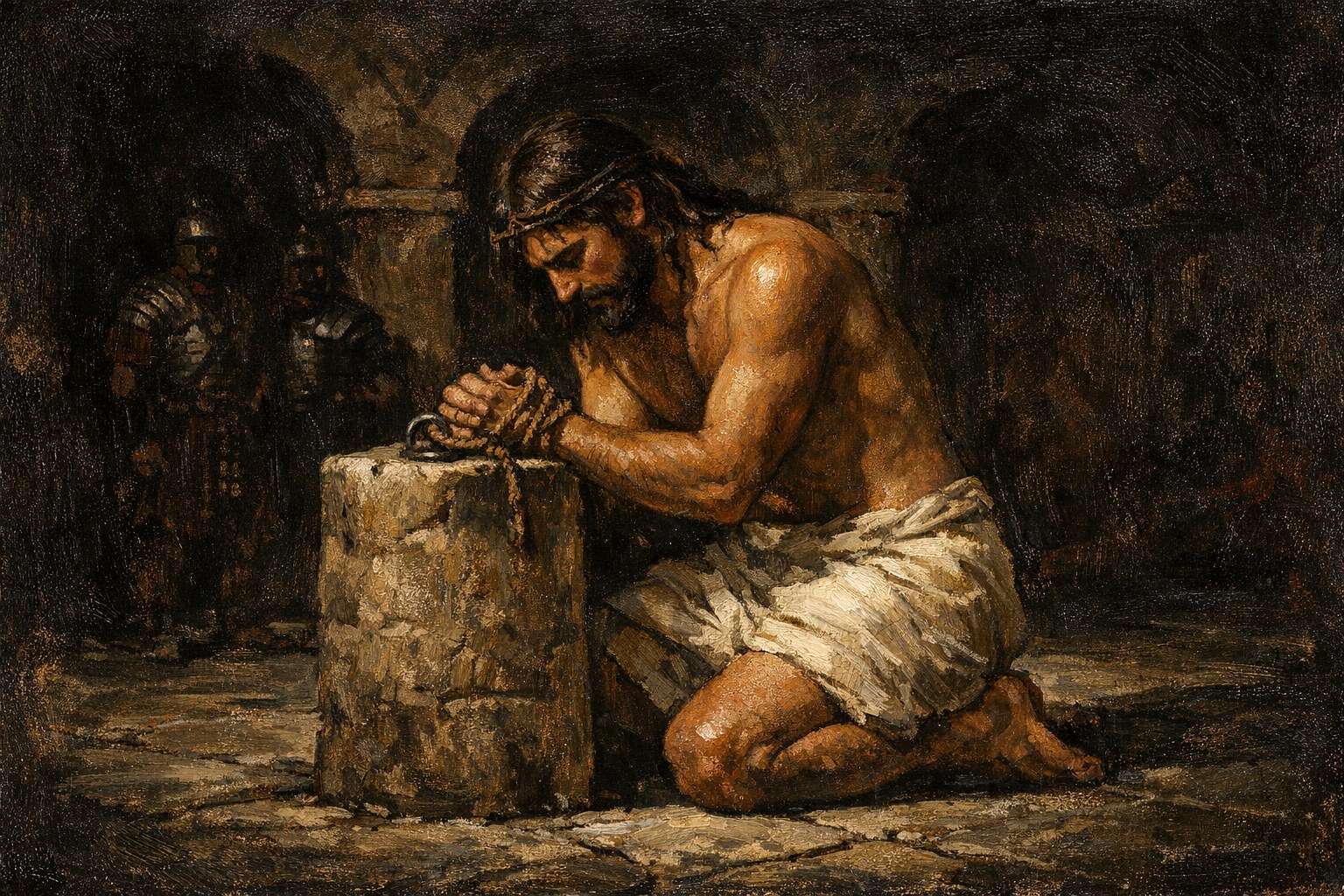
II.The Second Sorrowful Mystery
The Scourging at the Pillar
— Flagellatio Domini —
“But he was wounded for our iniquities, he was bruised for our sins: the chastisement of our peace was upon him; and by his bruises we are healed.”
— Isaiah LIII : 5
Roman scourging had no legal limit. The flagrum — leather thongs with bone or lead tips — counted ~120 strikes on the body the Shroud preserves. Far past the 39 lashes any Jewish court would have permitted (Deut 25:3). Pilate handed him over to the standard Roman procedure, and the Romans were thorough.
The economy of salvation is exact: the body that obeyed perfectly was torn for the bodies that did not. The flesh that mastered itself in the desert was given over to the men who could not master themselves. The wages of sin is the body of God broken in a Roman courtyard.
The Catholic man learns mortification at this pillar. The body that demands what the soul forbids is the body that put Christ here. Master it. The fasting, the cold shower, the refusal of the second drink and the third look — these are not extras. They are the small share of the cost.
Fruit of the Mystery — Mortification & Purity of Body
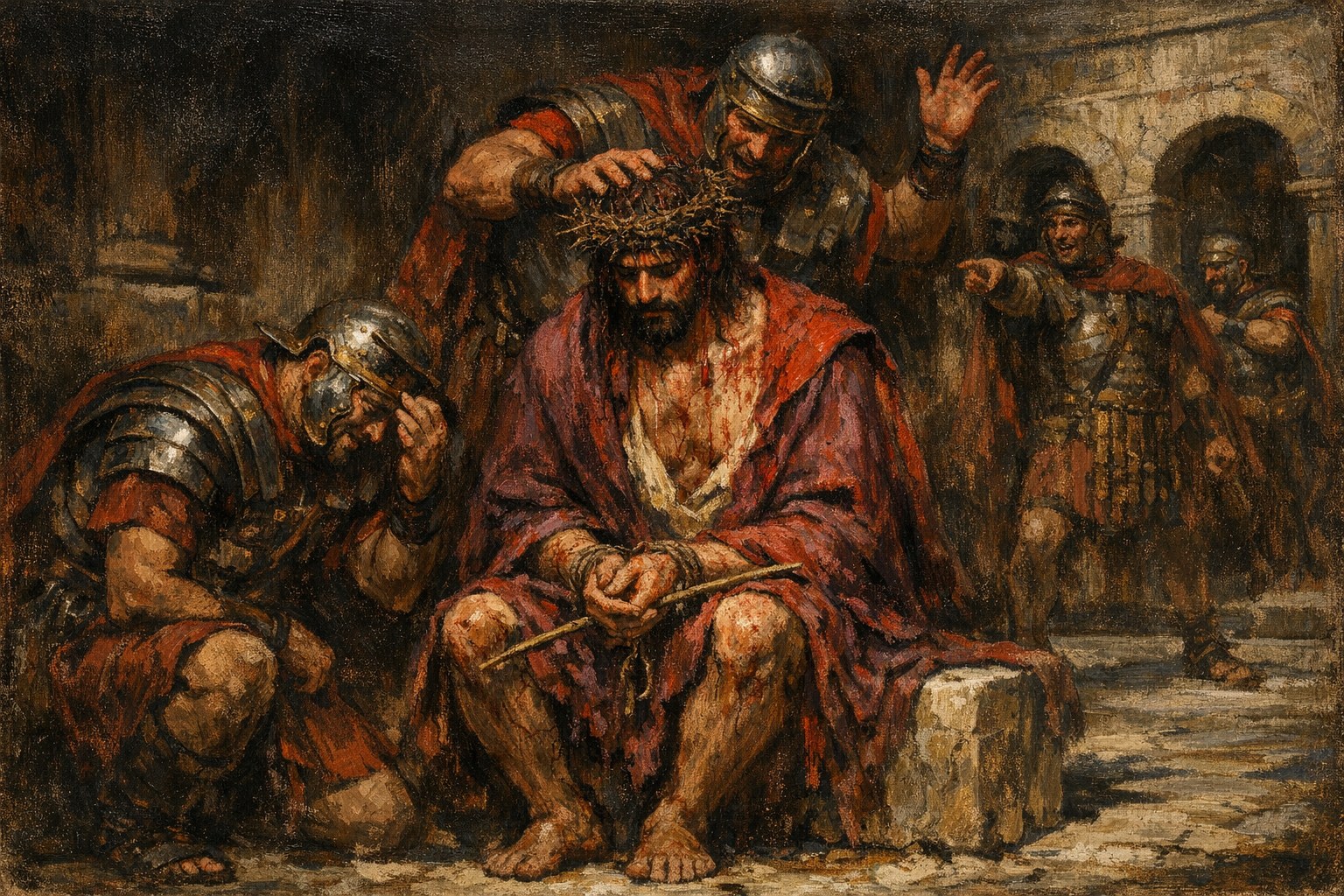
III.The Third Sorrowful Mystery
The Crowning with Thorns
— Coronatio Spinis —
“And platting a crown of thorns, they put it upon his head, and a reed in his right hand. And bowing the knee before him, they mocked him, saying: Hail, King of the Jews.”
— Matthew XXVII : 29
The scarlet cloak was the color of officers. The cap of thorns was a real crown — heavy, sharp, driving the curse of the fall (Genesis 3:18 — thorns also and thistles shall it bring forth to thee) into the head of the New Adam. The reed in his right hand was the scepter. Hail, King of the Jews. The mockery was prophecy. Every word of it.
The Catholic man learns this lesson here: when the world mocks Christ, it declares more truth than it intends. The scoffer thinks he is dismissing a fool. He is acknowledging a King whose authority he cannot escape. The kingship of Christ is not contingent on the world's recognition. It is contingent on nothing.
Hold the line. When they laugh, hold the line. When the office, the dinner table, the timeline turns its contempt on the Faith — hold the line. The man who needs the world's approval will lose his soul for it. The man who keeps his King's coin in his pocket can take their mockery without flinching, because his King has already taken theirs.
Fruit of the Mystery — Moral Courage & Contempt of the World
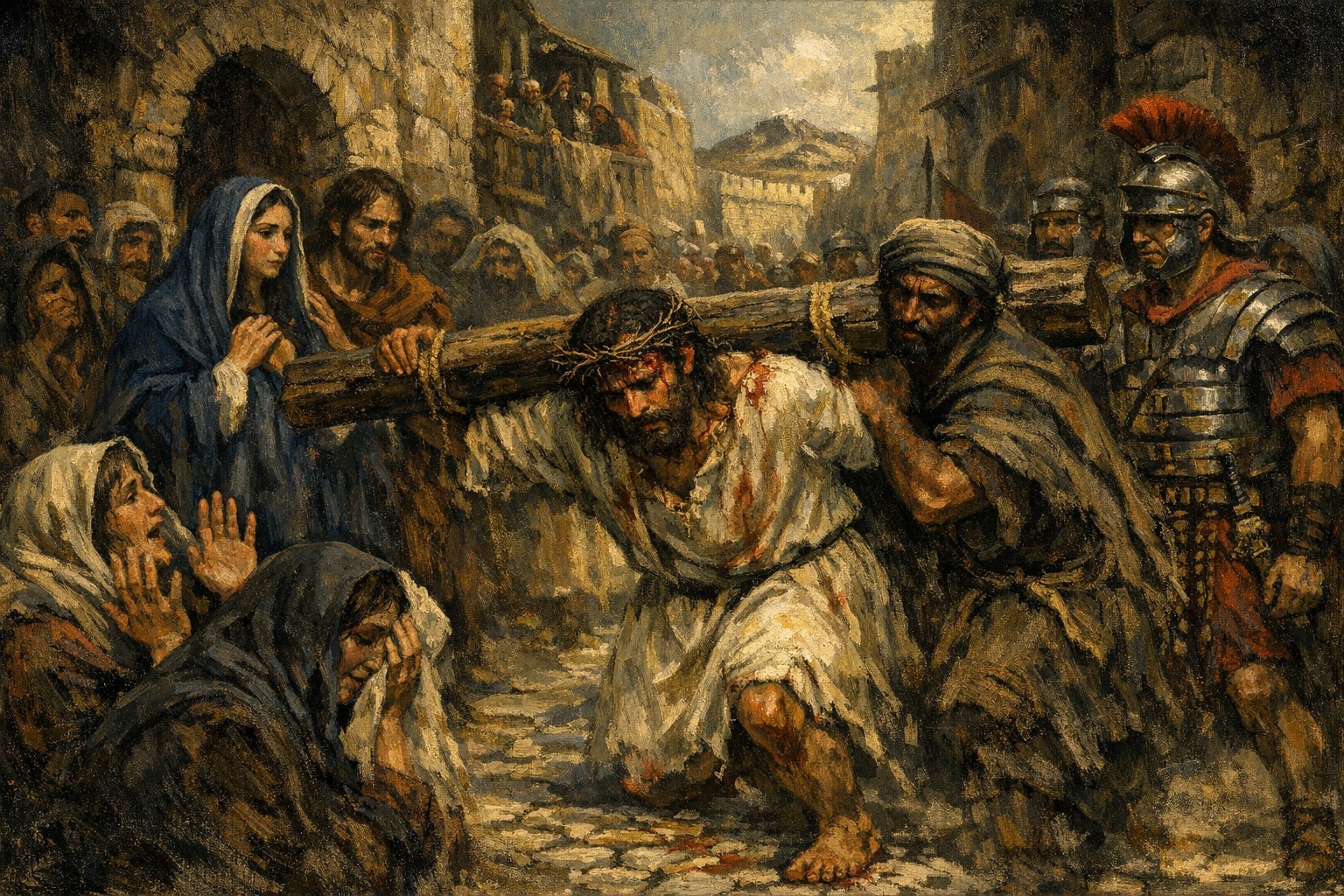
IV.The Fourth Sorrowful Mystery
The Carrying of the Cross
— Baiulatio Crucis —
“And going out, they found a man of Cyrene, named Simon: him they forced to take up his cross.”
— Matthew XXVII : 32
The Romans never made the condemned carry the full cross. The upright stake was already at Golgotha. The crossbeam — the patibulum, ~75-125 lbs of rough timber — was what he carried, arms outstretched and tied along its length, body bent under the weight. He had been awake through the night. He had been scourged past any human limit. He fell. He was raised up again. He fell again. He was raised again.
Simon of Cyrene was conscripted out of the crowd. A pilgrim from North Africa, in the city for Passover, pulled into a moment that defined the rest of his life. Mark names his sons (Mk 15:21 — Alexander and Rufus), suggesting they were known to the early Roman church. The moment Simon was forced to bear the cross of Christ was the moment Christ began to make a Christian out of him.
If any man will come after me, let him deny himself, and take up his cross daily, and follow me (Lk 9:23). Yours, not his — but his made yours possible. The cross you have been given is the cross that fits your shoulders. Take it up. Stop looking for another. Stop laying it down at every offense. He fell three times and got up three times — and the men who finally had to compel him were already inside the crowd, watching him do what they could not.
Fruit of the Mystery — Patience & Carrying One's Cross
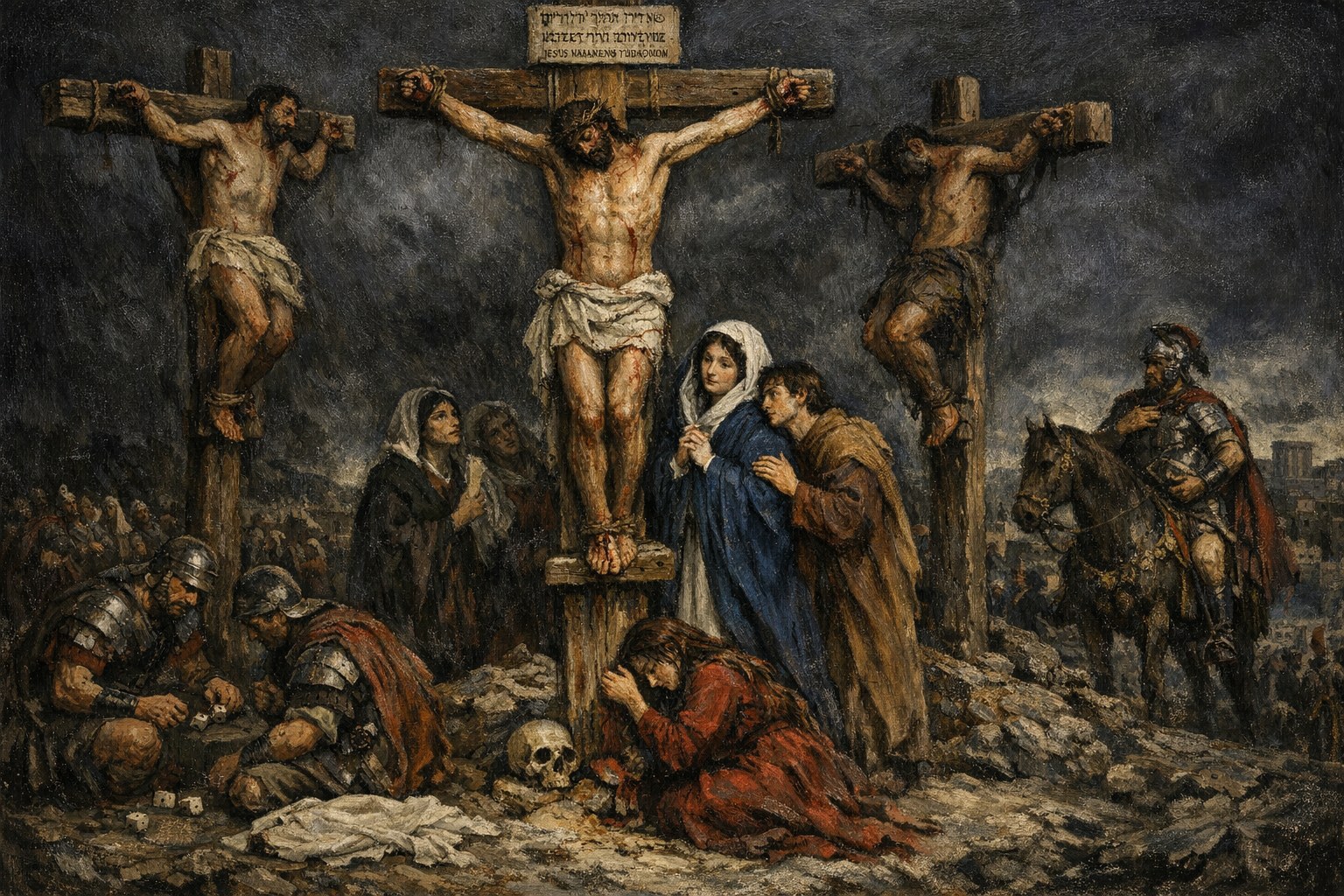
V.The Fifth Sorrowful Mystery
The Crucifixion of the Lord
— Crucifixio Domini —
“Jesus therefore, when he had taken the vinegar, said: It is consummated. And bowing his head, he gave up the ghost.”
— John XIX : 30
Three crosses on a low rocky knoll outside the western wall. The titulus over his head: Iesus Nazarenus Rex Iudaeorum, in three languages — Pilate refused to amend it. Mary at the foot of the cross — Stabat Mater dolorosa — standing, dignified, refusing to look away. John supporting her. Mary Magdalene clinging to the wood. The Roman centurion in mid-distance, about to confess that this dying man was the Son of God.
Seven words from the cross. Father, forgive them. Today you will be with me in paradise. Woman, behold thy son. My God, my God, why hast thou forsaken me? I thirst. It is finished. Father, into thy hands I commend my spirit. Each word a discipline for the dying man and for the Catholic men he was leaving behind. The forgiving of enemies, the welcoming of the contrite thief, the entrusting of the Mother to the disciple, the obedient cry of Psalm 22, the human thirst that touched the lips of the vinegar, the consummatum est of the work completed, the final commendation to the Father.
This is what your salvation cost. Not a figure of speech, not a metaphor — a Galilean rabbi, beaten past recognition, asphyxiating slowly on Roman timber, his Mother weeping at his feet, the sun veiled, the veil of the Temple rent in two from top to bottom, the rocks splitting. Pray for the grace of final perseverance — that what was bought with this price will not be lost on the day it is needed.
Fruit of the Mystery — Salvation & Final Perseverance
Pray it tonight.
He suffered all of this so that the suffering of his sons would have a meaning. The cross he chose has made the cross you carry redemptive. Pray the decade. Walk to confession. Take up your watch.
Per Crucem ad Lucem.
Through the Cross to the Light.
The other sets — Joyful · Glorious · Luminous · All four sets
Continue — Just War & the Catholic theology of legitimate force (CCC 2309)
And — Catholic Military Chaplains: the priests who walked into every American war. Red vestments for the fire of the Holy Spirit on Pentecost and the blood of the martyrs on the feasts of the Passion bind the same charity (Catholic Encyclopedia).
Questions on the Sorrowful Mysteries
What are the Sorrowful Mysteries of the Rosary?
The Sorrowful Mysteries are the five mysteries of the Passion prayed in the Holy Rosary: (1) The Agony in the Garden — Christ's prayer at Gethsemane the night before his Crucifixion, where he sweat blood (Luke 22:39-46); (2) The Scourging at the Pillar — Christ scourged by Roman soldiers (Matthew 27:26, John 19:1, Isaiah 53:5); (3) The Crowning with Thorns — Christ mocked as King of the Jews with a cap of thorns and a scarlet cloak (Matthew 27:28-30); (4) The Carrying of the Cross — Christ bears the patibulum to Golgotha, helped by Simon of Cyrene (Matthew 27:31-32, Luke 23:26-31); (5) The Crucifixion — Christ's death on the cross, with his Mother standing at the foot as the Stabat Mater (Matthew 27:33-50, John 19:25-27).
When are the Sorrowful Mysteries traditionally prayed?
The Sorrowful Mysteries are traditionally prayed on Tuesdays and Fridays. They are also prayed throughout Lent, especially on the Fridays of Lent, where their meditation on Christ's Passion aligns with the penitential season culminating in Good Friday.
What are the spiritual fruits of the Sorrowful Mysteries?
The traditional spiritual fruits of the Sorrowful Mysteries are: Agony in the Garden — conformity to God's will; Scourging at the Pillar — mortification and purity of body; Crowning with Thorns — moral courage and contempt of the world; Carrying of the Cross — patience and the carrying of one's daily cross; Crucifixion — salvation and final perseverance.
What does "Stabat Mater dolorosa" mean?
"Stabat Mater dolorosa, juxta crucem lacrimosa" is the opening of the medieval sequence Stabat Mater (~13th century), translated: "The sorrowing Mother stood, weeping by the cross." The Stabat Mater is the canonical Catholic devotional prayer commemorating Mary's seven sorrows and her presence at the foot of the Cross (John 19:25). Mary stood — she did not collapse or swoon. The Catholic iconographic tradition renders her upright, dignified, the Mater Dolorosa who refused to look away from her dying Son.
Did Christ carry the full cross to Calvary?
No. Roman crucifixion procedure required the condemned to carry only the patibulum (crossbeam, ~75-125 lbs); the upright stipes was a permanent fixture at the execution ground. The frequent Western iconographic trope of Christ carrying the entire full cross is medieval embellishment, historically incorrect. The Fourth Sorrowful Mystery — the Carrying of the Cross — is properly meditated as Christ bearing the patibulum across his shoulders along the Via Dolorosa, with Simon of Cyrene compelled to assist (Matthew 27:32, Mark 15:21).
Were the nails driven through Christ's palms or wrists?
At the wrist — either through the carpal bones themselves (Pierre Barbet's A Doctor at Calvary, the wrist's 'Destot's space') or angled through the base of the palm to exit at that same point (Frederick Zugibe's The Crucifixion of Jesus) — not through the unsupported open palm of most paintings. The Shroud of Turin bears the wound at the back of the wrist, and modern crucifixion forensics agrees a flat-palm nailing cannot bear body weight; the soft tissue would tear through. Scripture's 'hands' (John 20:25-27) is no contradiction — the Greek cheir includes the wrist. A wrist-area nailing is the anatomically defensible depiction, and the Sanctum Visual Rosary renders the Crucifixion accordingly.
What is the supernatural darkness mentioned at the Crucifixion?
The Synoptic Gospels (Matthew 27:45, Mark 15:33, Luke 23:44) record that "there was darkness over all the land" from the sixth hour to the ninth hour — noon to 3 p.m. on Good Friday — at the time of Christ's Crucifixion. This was not a solar eclipse, which is astronomically impossible at the Passover full moon. The Catholic Tradition understands this as supernatural divine darkness — a sign in the heavens that the Sun of Justice was being crucified at the appointed hour.